Friday, May 17, 2013

Njavara Rice

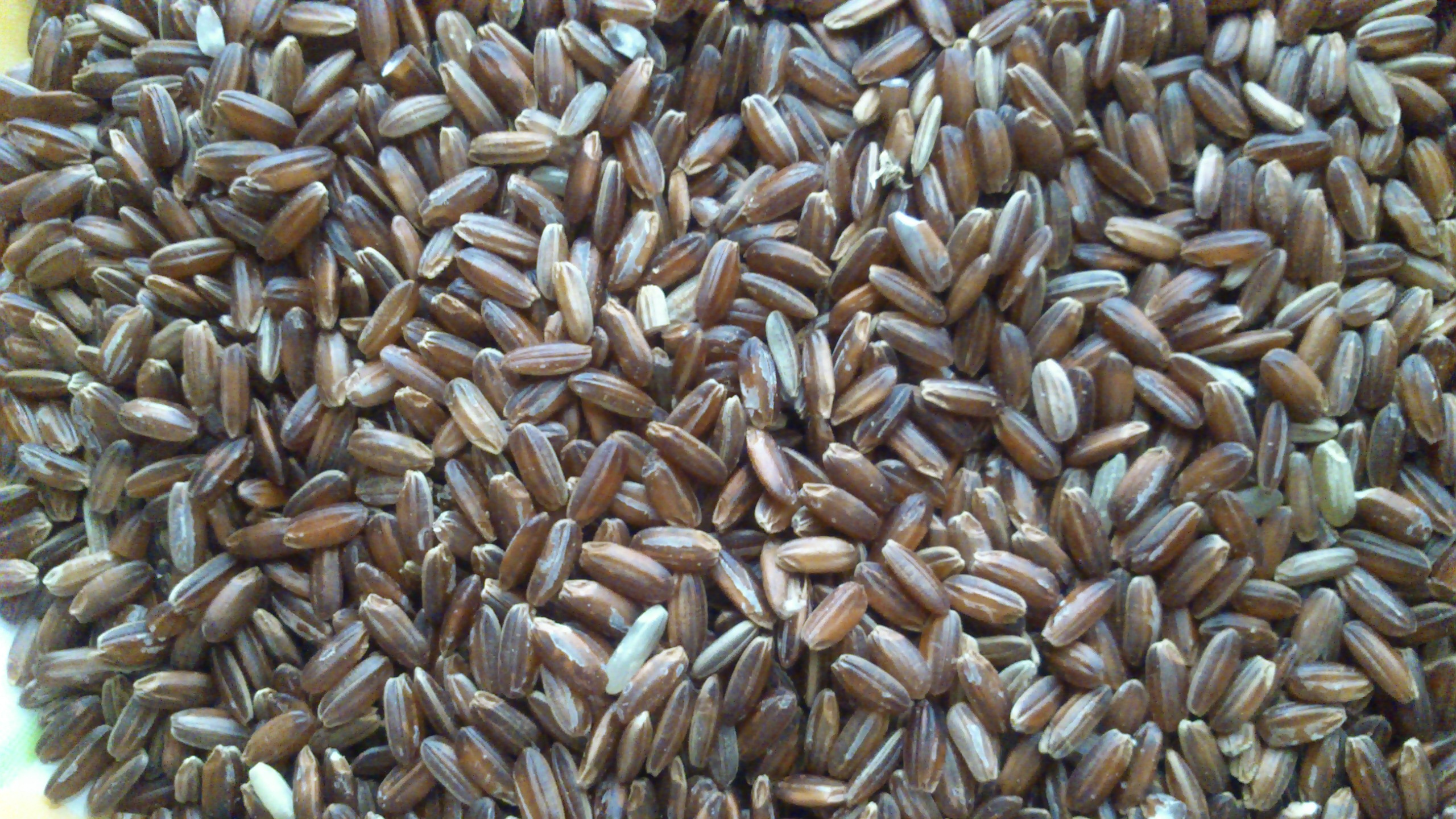
A couple of months back I bought a kilo of Njavara rice. I was sorely tempted to buy it when I saw the dark brown unpolished rice. In the hustle and bustle of life, I somehow missed out making rice out of it. Today, being a Friday, a holiday, I did some spring cleaning. Lo, there lay the packet of rice! The menu for lunch was instantly decided. Even while washing it, the colour did not run. That told me the rice was authentic. Cooking it took longer than usual but that was not a dampener. The cooked rice had such a unique taste. Rice with ripe mango pachadi (a traditional wet dish made with ground coconut, cumin seeds, mustard seeds, green chillies and yoghurt), cowpeas dry dish (called Upperii.e. cowpeas cooked with turmeric, chilli powder and salt and garnished with fried onions and fresh coconut scrapings) and some pickle – it was a yummy and delicious lunch.

Njavara Rice, endemic to Kerala

Njavara Rice, endemic to Kerala

Njavara, with medicinal properties, is an endemic rice variety of Kerala. I am proud that there are eco farms that cultivate this rice in my home district of Palakkad, in Kerala. It belongs to the Oryza genus of grass and is a wild form of the cultivated rice Oryza Sativa commonly known as Asian rice. Njavara rice has a prime place in Ayurveda – both for internal consumption as Kanji (porridge) and external use like in Njavara Kizhi which is part of Panchakarma treatment.

Njavara when consumed internally is said to remove the ills affecting the respiratory, circulatory and digestive systems of the body. It’s cultivation is just like that of paddy. A study at the Regional Agricultural Research Station, Pilicode, described Njavara as a unique cereal having high content of free amino acids. A study conducted at the Agricultural University, Vellanikkara, Thrissur said that “being a rare indigenous genetic resource of high value and unique production and quality characteristics, it is necessary that Njavara is studied thoroughly, conserved, propagated and utilised appropriately.”

Though I have heard about Njavara, I have never known much about it till I explored it today. Worse still, I had never tasted it ever till today! It is time we protected these indigenous treasures from extinction.

Tuesday, April 23, 2013

World Book Day Thoughts

Today is World Book & Copyright Day. Can't have a better day to celebrate it as today is the birthday of the Bard of Avon, William Shakespeare and the day the celebrated Spanish author Miguel de Cervantes was buried. A birth and a death. In between is the journey of life. With technology changing every minute, to me the power of the Book is still unquestionable. Yet as an educator I can see that the love for books and art of reading books is dying.
My books
How did I come to be an ardent book lover? I remember fondly my childhood days. Daddy used to read books to us just before we went to bed. And the most vivid memory is that of Dad reading Jim Corbett’s stories to us. Probably because we live in the midst of coffee / tea plantations with forests and wildlife around in Valparai, Anamallais, I could connect that with the topography mentioned in the stories. Dad had a knack of reading it in such a way that it painted a picture in the mind’s canvas. He bought us lots of books. During summer holidays when we spent time at Dad’s work place, he introduced us to the books of Enid Blyton. My guess is it is those books that got me hooked to reading – not surely the classics. Abridged editions or original versions were not good enough to inspire me read more.
Later as I grew up, I not only started reading but also collecting books and build a library. I do have lots of books now and would love to keep on reading. However, today, when I see students around me not really reading, I wonder if it is because many of us, English teachers, focussed first on classics. (We are old school, you know! I plead guilty of this till recently when I laid hands on a wonderful book called Caring Hearts, Critical Minds by Steven Wolk, which completely changed my perceptions and brought in refreshing insight.) We wanted them to read Oliver Twist and Three Musketeers or Anna Karenina and Moby Dick first. There is nothing in them that would hold their attention. I must also add that those books were written by adults for adults. Yet, we asked our students to read them.
Instead if we ask them to read something they can relate to - like something they see around them in the real world - may be they would find reading a more engaging experience. For example reading books like Freak the Mighty (Philbrick 1993) that explores friendship or the award winning Bamboo People (Mitali Perkins 2012) that hinges on the redemptive power of love, family and friendship. Or Copper Sun (Sharon Draper 2006), the riveting story of the trials and tribulations of an African girl and the practice of slavery. Any Small Goodness (Tony Johnston 2003) a story steeped in hope, love and warmth. Or Scrawl (Mark Shulman 2010), a juvenile fiction that deals with social issues like bullying and peer pressure.
The sad truth is we teach reading to test. Not for the pure pleasure and love of it. We ask them the very evident questions, not those that will make them think. “Instead of teaching ‘Reading’ as a school subject”, how about teaching “reading filled with real purposes, experiences and emotions of life” asks Steven Wolk.
Yes, we need to do this to stoke the embers of this dying fire of reading. For even in this techno savvy geeky world, everything boils down to reading. Adult life is full of that. Read, comprehend, analyse, synthesize, extrapolate and create completely new things out of what you read. Granted what you have to read may not be in hard copy but surely it is in the form of an e-book, kindle edition and or the plain and simple PDF. I hasten to add that this is also reading, but minus the essence. I mean the heady fragrance of a brand new book or the musty smell of an old book. To a connoisseur of books both are sure to gift a very special olfactory experience. Something that makes one want for more! Sniff, sniff & sniff!!!
By the way, did you know that there are perfumes that you can spritz on your e-reader or kindle to make it smell like a paper book? It is like bottled scent of ink on paper – check this one out! Eau de books??? Or is it meant to be worn as an actual perfume? In any case, I doubt if even book lovers would love to walk around smelling like a book. It is great to sniff will it be so to walk around wearing it on your sleeve?
Smell of a book
I think language teachers have their tasks cut out. It is time that schools, teachers and parents helped today's digital generation discover the simple joys of reading books. Meanwhile, I have rediscovered the joy of reading, thanks to a lot of books that my children, Aathira and Praveen, gifted me for my birthday. From The Immortals of Meluha I am traversing into the absorbing tale of the The Secret of the Nagas (Amish Tripathi – the second in the The Shiva trilogy).
Are you reading too? Happy World Book Day to you!
** Caring Hearts, Critical Minds; Steven Wolk, Stenhouse Publishers; Page 191
Sunday, April 14, 2013

The Nostalgia of yet another Vishu


Today was Vishu, a very auspicious day for a Keralite. A festival that is the harbinger of prosperity, plenty and joy. A lot of very special images fleet across my mind's canvas...
Even Nature is ready for the festivities. The Labernum is laden with flowers. Mangoes and Jackfruits green and ripe are aplenty. The Sun is bright and is almost above the line of the equator.
The eve of Vishu montages:Mummy & all of us arranging the Kani, the special arrangement of everything auspicious and yellow, so that we can view it first thing in the morning...The array of yellow coloured fruits and vegetables like mangoes, jackfruit, golden cucumber or the Kani Vellari, lemon, home grown bananas...The mirror adorned with gold chains and stringed jasmine flowers/ tulasi petals, the idol/photo of Krishna, the Kasavu Veshti, the Bhagavad Gita and everything else from raw rice to halved coconuts...The dazzling Labernum blooms aka Kanikonna... A host of other flowers to decorate the Lord from the ordinary hibiscus to the sacred Tulasi leaves and to the beautiful and enchanting Lotus flowers the Daddy will get from our Lotus Pond...The lighted lamps, the wafting fragrance of agarbathis and camphor...
Arranged so that this sight is what one sees first in the morning
The morning of Vishu memories:
Mummy waking us up one by one, covering our eyes with her hand, getting us to wash our faces without opening our eyes and then making us sit in front of the necklace adorned mirror...
Lo! You open your eyes and see your reflection in the mirror decked of course in gold and flowers...
As children the best thing to remember was the Vishu Kaineettam... (No pocket money those days. All you will get during the entire year would be a few rupees as Kaineetam, that the elders would give you!)
Then the very interesting part for children - the bursting of crackers & fireworks... (Gradually this became a much toned down affair, thanks to the awareness that child labour was rampant in the firework factories in Sivakasi and of the chemical pollution it releases into the air !)
When we had our cattle, Mummy used to take the Kani into the cattle shed for the cows to see...
All reminders of times when we lived close to nature... and treated every living being with respect and love...
Then the rush of local people - kids, young and old, to collect their share of Kaineettam from Daddy...
Sumptuous feasts...
Times when all would come home for Vishu... the joy, the merriment, the bonding and the camaraderie...
Today am at Sharjah. Far away from my loved ones, physically at least. Virtually I was even able to see some of the vishu kanis... The eve of Vishu gave me actually the blues... (which I tried rather unsuccessfully to beat by watching the Malayalam movie Amen in the nearest theatre!)  How I missed being at home during this festive time! Made a decent feast for myself with sambhar, rice and koottu curry - yet my mind, like a disobedient child, ran back to the courtyards of Sreyas (our home is named that); in the midst of Dad and Mom...
How true the age old adage is: East or West, Home is truly the best! Only one has to leave the shores of our land to realize this!!
Flowers of the Indian Labernum or the Kani Konna
Happy Vishu to all... May this Vishu bring you joy, peace, health and prosperity!!!